Pixany AI
Back to library
Vertical Layered Diorama Concept Art Prompt for Sci-Fi Film 1
ImageNeeds reference image

Vertical Layered Diorama Concept Art Prompt for Sci-Fi Film

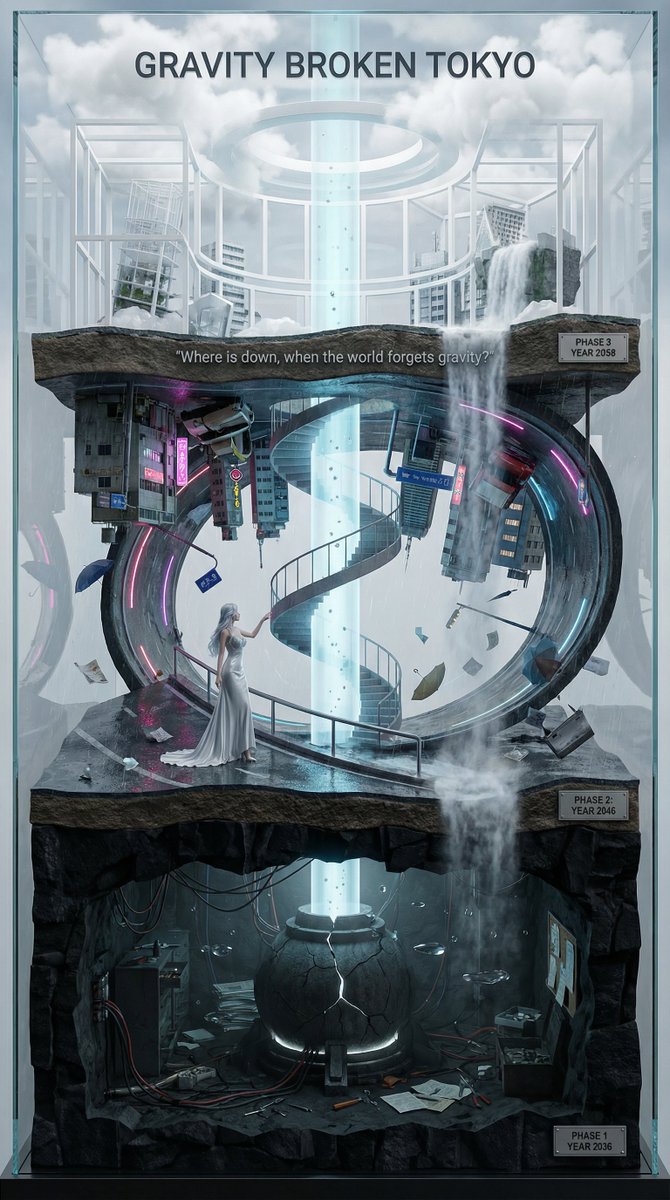
An extremely detailed meta-prompt for Nano Banana Pro (using Thinking Mode) combining 'Gravity Prompt' and 'Movie Vertical Miniature Prompt' to generate a complex, vertical, layered diorama visualization of a fictional sci-fi film titled 'GRAVITY BROKEN TOKYO'. The prompt specifies roles, steps, visual styles, gravity effects, and typography.

Prompt
You are an **architect and concept artist who visualizes story structures**.
Analyze the provided input text (the movie synopsis) and generate a **"Vertical Layered Diorama"** where the height direction represents the timeline.

The character in the attached reference image should be placed in the "Present (Middle Layer)" or "Future (Top Layer)" of this vertical structure, acting as the **storyteller/time traveler**, and posed to **look down on the past / look up at the future**.

---

## ▼ Instructions for Generation Process (Nano Banana Pro: Thinking Mode)

1. **[Step 1: Timeline Mapping]**: Decompose the synopsis into three time phases and assign them to physical layers.

   * **Bottom Layer (Past/Origin)**: Cause of gravity collapse, sealing, deep underground. Dark and heavy tone.
   * **Middle Layer (Present/Conflict)**: Survival and conflict in gravity-broken Tokyo. Vivid and dynamic tone.
   * **Top Layer (Future/Conclusion)**: Birth of a new gravity order, hope or ruin. Open and symbolic tone.
2. **[Step 2: Connection Design]**: Design the layers so they are not disconnected, but physically connected by elements such as **Gravity Well pillars / inverted spiral staircases / magnetic elevators / waterfalls where falling turns into rising**.
3. **[Step 3: Text Integration]**: Place the movie title in a stable location at the very top or bottom, and engrave famous lines on the **layer boundaries**.

---

## ▼ Design and Style Specification

* **Composition/Layout**: **Vertical Cross-section / Tower structure**. Aspect ratio is vertical (**9:16**). Viewpoint is **slightly above the front**, at an angle that shows the thickness and depth of the layers.
* **Taste**: **Precise museum model, geological cross-section, surreal architecture**. Express different eras and materials in each layer (concrete → neon metal → white structure on clouds) while integrating them as one giant object.
* **Texture/Image Quality**: Photorealistic, precise detail, **8k**. Raindrops, wet asphalt, reflections, fog, volumetric light.
* **Gravity Expression (Important)**:

  * Tokyo roads **curve 90 degrees as a continuous surface**, where the ground becomes a wall, and then arches to the ceiling, connecting in a **loop**.
  * Buildings, signs, cars, and pipes **protrude vertically** from the curved surface, and landmarks exist **upside down** suspended in the air.
  * Depict as a **physically continuous urban structure**, not just a reflection.
  * Light sources match the reality of a rainy night (reflections of neon and streetlights, diffused light through clouds).

---

## ▼ Input Text (Fictional Movie)

**Title**: **{argument name="Movie Title" default="GRAVITY BROKEN TOKYO (Gravity Fault City Tokyo)"}**
**Genre**: Sci-Fi Thriller / Disaster / Human Drama

**Synopsis**:
One night, due to the fracture of the "Gravity Lattice" above Tokyo, the city's gravity lost its uniformity. Roads bend into the sky, buildings lose their up and down, and falling chooses a direction. People survive by redefining "where the ground is." The narrator (reference character) dives across time to the origin of the gravity collapse, struggles in the current city, and reaches the new order of the future.

### [Bottom Layer / Past and Origin] (PHASE 1: YEAR 2036)

* **Setting**: Deep underground research complex. Black basalt-like strata, old wiring, gravity control reactor "Atlas Core."
* **Description**: Suggests that the device meant to "fix" gravity instead triggered the "tearing" of gravity. Tools and paper documents are scattered on the floor, and water droplets float horizontally due to gravity disturbances.
* **Tone**: Dark, oppressive. Warning lights, fine dust, the stillness of low gravity.

### [Middle Layer / Present and Conflict] (PHASE 2: YEAR 2046)

* **Setting**: The center of gravity-broken Tokyo, where rain continues to fall. A continuous city where **wet asphalt curves 90 degrees, becoming a wall, and continuing to the ceiling**.
* **Description (Reflecting Gravity Prompt)**:

  * Roads rise vertically and then arch overhead to loop.
  * Landmarks are suspended upside down, and road signs protrude into the air.
  * Neon lights bleed along the curved surfaces in the fog and light rain, and reflections establish the light of a real rainy night.
* **Character Placement**: Place the reference character in the **"Present" of the Middle Layer**. Grasping a railing or pipe with one hand, pointing to the light of the upper layer with the other. Gaze **looking down on the past (bottom layer) while looking up at the future (top layer)**.
* **Tone**: Dynamic, tense. People's evacuation routes continue along the "wall roads."

### [Top Layer / Future and Conclusion] (PHASE 3: YEAR 2058)

* **Setting**: The "Stable Gravity Layer" above the clouds. City remnants are rearranged, forming a new residential area composed of white frame structures and transparent materials.
* **Description**: Ambiguous whether the gravity lattice was "repaired" or if a "new direction" was accepted. A pale column of light from the gravity well extends into the sky, connecting to the darkness below.
* **Tone**: Open and symbolic. Hope and unease coexist.

---

## ▼ Connection Points (Gimmicks connecting the layers: Required)

* **Gravity Well Light Column**: A column of pale blue volumetric light penetrating from the core of the bottom layer to the top layer. Particles flow upward.
* **Inverted Spiral Staircase**: "Up" and "down" switch midway. Small year plates on the staircase railing.
* **Waterfall where Falling Turns into Rising**: The water flow reverses at the boundary, emphasizing the layer separation.

---

## ▼ Visual Elements (Motifs to emphasize)

* Wet asphalt, trajectory of raindrops, neon reflections, fog, volumetric light.
* Curved City: Roads, architecture, and signs bend as a **continuous surface**, forming a **physical loop**.
* Small objects floating in the air (umbrellas, paper scraps, tools, petals) visualize the disturbance in the direction of gravity.
* Material changes in each layer: Rough rock stratum underground → Wet concrete and metal in the present → White structure and transparent material in the future.

---

## ▼ Text Instructions (On-screen Typography)

* **Title**: "**{argument name="Title" default="GRAVITY BROKEN TOKYO"}**"

  * Placement: **Sky of the Top Layer**, or engraved on the pedestal of the bottom layer.
  * Font: Inorganic sans-serif, movie poster style.
* **Famous Line** (Engrave on layer boundaries):

  * `{argument name="Famous Line" default=""Where is down, when the world forgets gravity?""}`
  * Placement: **Boundary between Middle and Top Layers**, like a sculpture on the landing of the inverted staircase or the edge of the light column.
* **Timeline Display (Optional)**: Small next to each layer

  * `PHASE 1 / YEAR 2036`
  * `PHASE 2 / YEAR 2046`
  * `PHAS
Author
Community
Published
Jan 4, 2026
Use cases
Infographic / EducationPoster / Flyer

More prompts like this

Infographic / Edu Visual - Object-to-Building Transformation Prompt
Nano Banana Pro

Infographic / Edu Visual - Object-to-Building Transformation Prompt

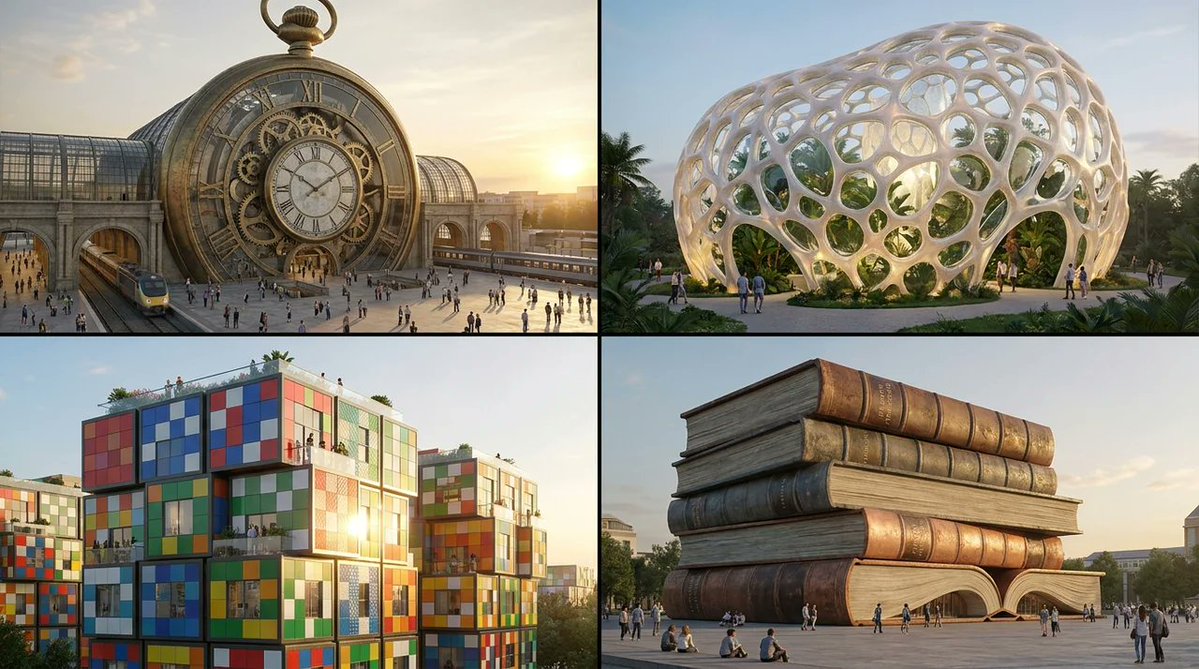
Turning random objects into buildings. 2x2 grid, do this for 4 different random objects. Concept: Turn objects into a landmark building that could exist. 1. ANALYZE INPUT (Massing & Structure): Mass: (Monolithic/Fragmented/Stacked/Spindly) Surface: (Reflective/Porous/Layered/Patterned) Mechanism: (Static/Kinetic/Modular) 2. AUTO-SELECT BUILDING TYPE: IF Monolithic + Stone-like → Museum IF Reflective + Aerodynamic → Skyscraper IF Modular + Stacked → Housing complex IF Porous + Organic → Botanical conservatory IF Kinetic + Mechanical → Transit hub 3. EXECUTE: Golden-hour exterior render, people for scale, plausible materials, cinematic wide lens.

@Gadgetify
Infographic / Edu Visual - Product Reference Sheet Workflow
Nano Banana Pro

Infographic / Edu Visual - Product Reference Sheet Workflow

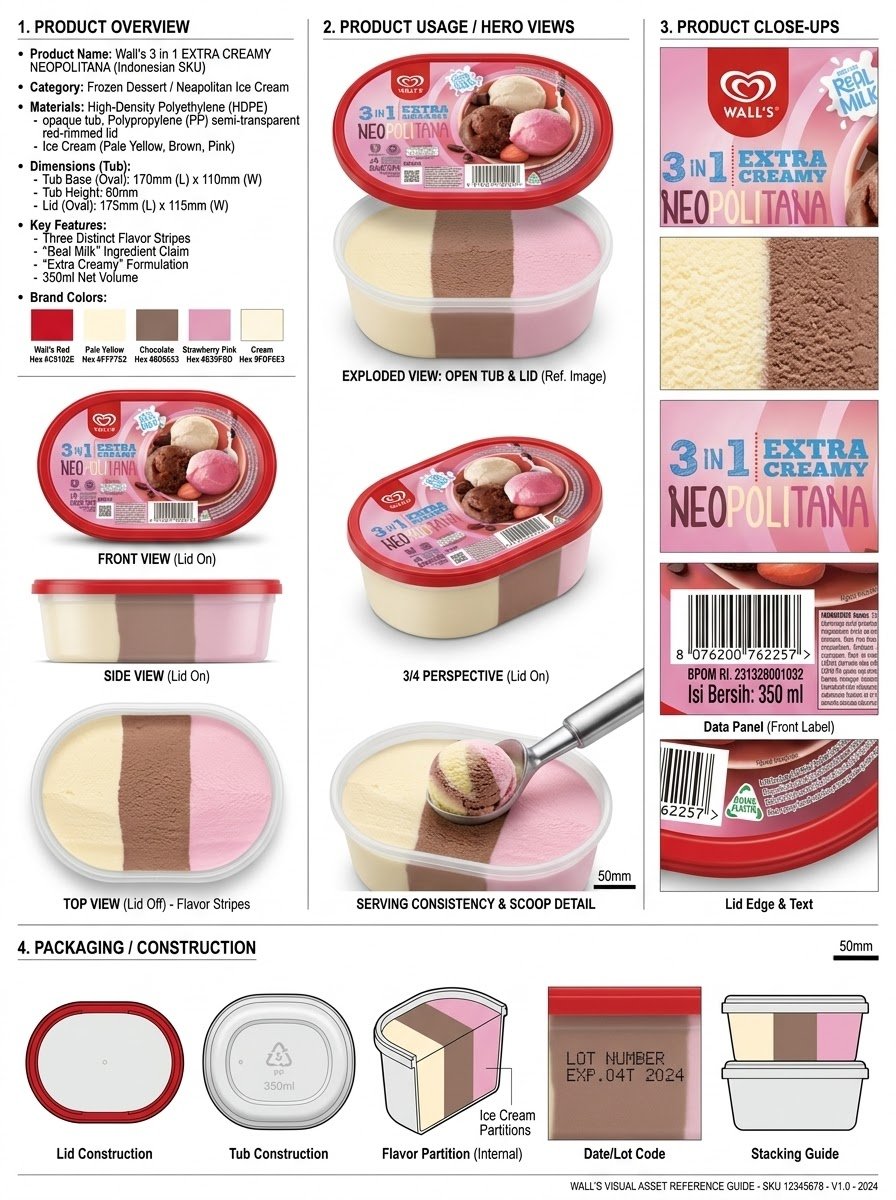
Analyze the product and create a high-resolution, photorealistic, professional advertising reference sheet containing these four sections, on a clean white/neutral studio background, premium commercial product photography, soft controlled lighting, realistic materials, sharp details, subtle shadows, and a professional editorial grid. 1. PRODUCT OVERVIEW; name, category, materials, dimensions/size, key features, and brand colors. 2. PRODUCT USAGE/HERO VIEWS - front, back, side, 3/4, and functional/use view where relevant. 3. PRODUCT CLOSE-UPS - logo/label, texture/material, key components, packaging details, and other important identifying features. 4. PACKAGING / CONSTRUCTION - relevant packaging or structural views where applicable. The entire sheet must function as a visual continuity bible for AI image/video production. Every product view must depict the exact same physical product with absolute consistency. Do not redesign, add variants, alter branding, or change proportions. Use cean typography, clear section labels, thin dividers, balanced spacing, sophisticated production-design aesthetic.

@Olatunde AI
Infographic / Edu Visual - Handwritten Style 3-Step Process Slide
Nano Banana Pro

Infographic / Edu Visual - Handwritten Style 3-Step Process Slide

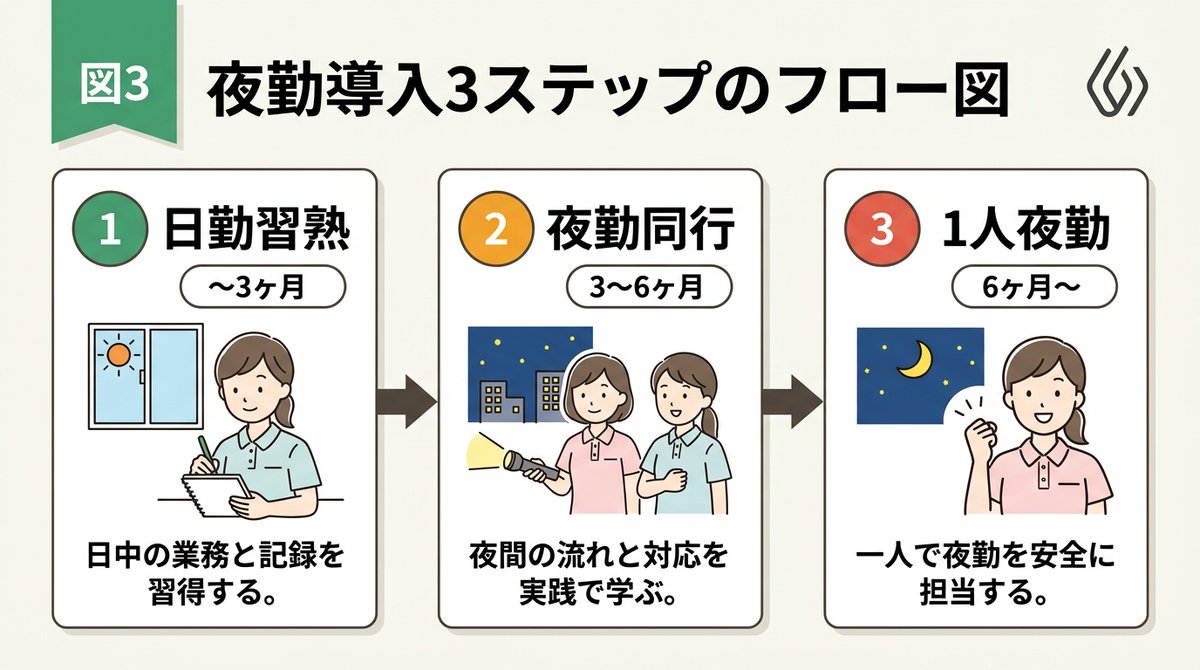
[Input Data] - Overall Title: {argument name="main title" default="3-Step Flowchart for Night Shift Introduction"} - Step 1: Title "{argument name="step 1 title" default="Day Shift Mastery"}" / Period "{step1Period}" / Description "{step1Desc}" - Step 2: Title "{step2Title}" / Period "{step2Period}" / Description "{step2Desc}" - Step 3: Title "{step3Title}" / Period "{step3Period}" / Description "{step3Desc}" - Color Theme: {argument name="color theme" default="green"} [Structure and Layout Specifications] - Style: A clean and friendly 3-step flowchart illustration suitable for Japanese business slides, educational manuals, or internal documents. 16:9 landscape slide configuration. - Background: Clean off-white or solid white background. - Top Title: - Place "Figure 3" or a step badge in the upper left, and to its right, draw a large Japanese main title "{mainTitle}" in a bold, easy-to-read Gothic font. Place a small, clean abstract logo mark at the right edge. - Step Card Arrangement: - Three beautiful rectangular cards arranged side-by-side. Placed in order from left to right, connected by thick arrows. Each card border is color-coded neatly according to the color theme ({colorTheme}). - Card 1 (Left) Interior: - Draw a circular badge "1" and the Japanese title "{step1Title}" prominently. Below that, a capsule label saying "{step1Period}". - In the center, place an illustration of a Japanese woman with a gentle hand-drawn touch taking notes, and a window showing the sun. - At the bottom, place the Japanese description "{step1Desc}". - Card 2 (Center) Interior: - Draw a circular badge "2" and the Japanese title "{step2Title}" prominently. Below that, a capsule label saying "{step2Period}". - In the center, place an illustration of two Japanese women with a flashlight, night sky, and buildings. - At the bottom, place the Japanese description "{step2Desc}". - Card 3 (Right) Interior: - Draw a circular badge "3" and the Japanese title "{step3Title}" prominently. Below that, a capsule label saying "{step3Period}". - In the center, place an illustration of the night sky and crescent moon, and a Japanese woman smiling with a victory pose. - At the bottom, place the Japanese description "{step3Desc}". [Quality and Font Specifications] - Simple, clean 2D illustration, flat design, crisp clear line art. - All text must be accurately drawn in readable Japanese fonts (Gothic) without spelling errors. - Exclude all 3D effects, shadows, laptop mockup backgrounds, or camera tilt; display the flat diagram itself across the entire screen. - Aspect Ratio: --ar 16:9

@AI Guide-Note - 実務で使えるAI活用メディア
Infographic / Edu Visual - Handwritten Memo Recipe Illustration
Nano Banana Pro

Infographic / Edu Visual - Handwritten Memo Recipe Illustration

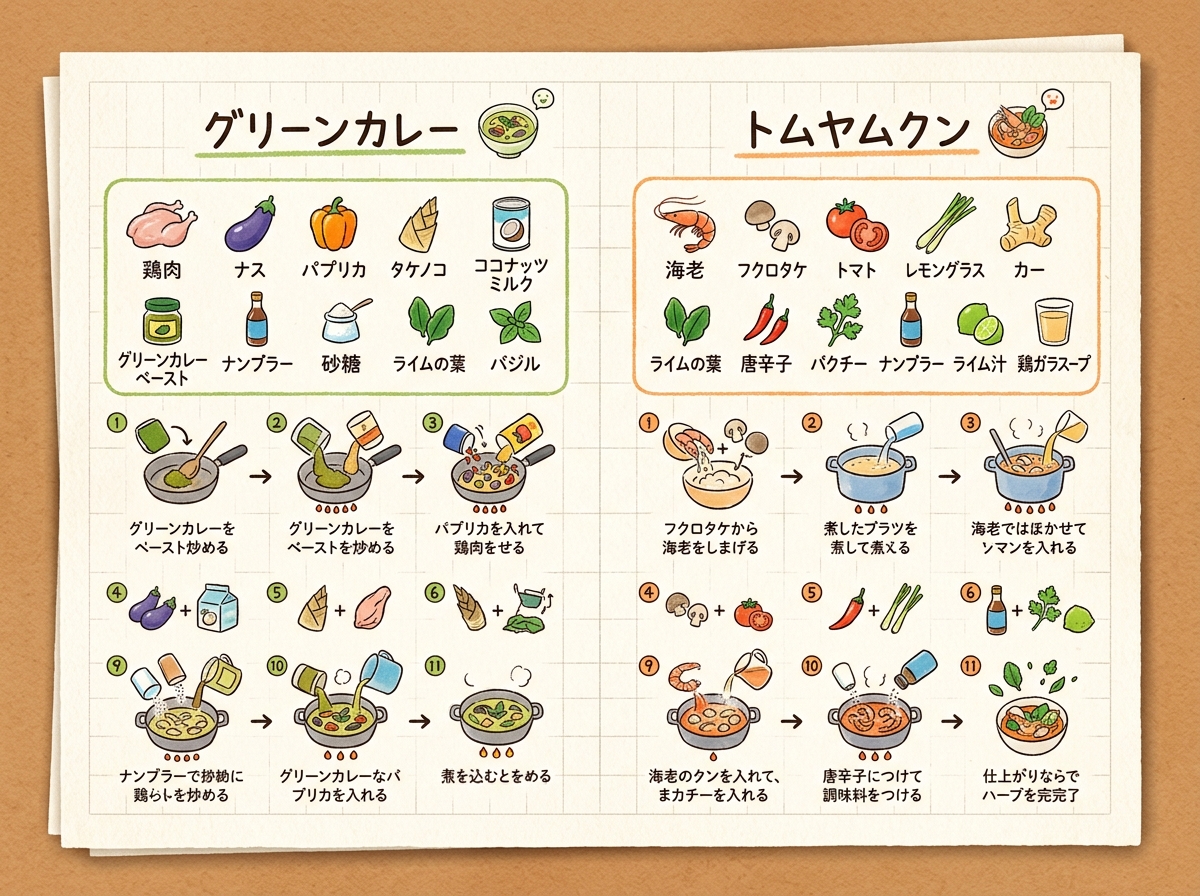
[Input Data] - Dish Name (Left Page): {argument name="dish name left" default="Green Curry"} - Ingredients List (Left Page): {ingredientsLeft} - Cooking Steps (Left Page): ①{stepLeft1} → ②{stepLeft2} → ③{stepLeft3} - Dish Name (Right Page): {argument name="dish name right" default="Tom Yum Goong"} - Ingredients List (Right Page): {ingredientsRight} - Cooking Steps (Right Page): ①{stepRight1} → ②{stepRight2} → ③{stepRight3} - Color Theme: {argument name="color theme" default="organic natural colors"} [Structure and Layout Specifications] - Style: A flat 2D handwritten-style infographic recipe illustration drawn on a piece of rustic off-white notepad paper (grid paper) with thin grid lines and warm paper texture. - Background and Composition Constraints: Do not draw physical books, three-dimensional notebook outlines, page thickness, shadows, or realistic photo background elements like wooden tables (Absolutely NO wooden table, NO realistic book mockup, NO book thickness, NO notebook pages, NO realistic photo background. It must be a flat 2D vector layout directly on the textured grid notepad paper canvas). - Left Side Layout: - Large handwritten Japanese title "{dishLeft}" at the top. - Below that, the ingredient list "{ingredientsLeft}" drawn with neat vertical bullet points in handwritten Japanese and simple food illustrations. - The lower half features cooking steps "①{stepLeft1} → ②{stepLeft2} → ③{stepLeft3}" arranged in a horizontal or vertical arrow flow. Include cute hand-drawn illustrations that match each step's content (e.g., cutting, stir-frying, simmering). - A delicious-looking illustration of the finished "{dishLeft}" dish in the bottom left. - Right Side Layout: - Large handwritten Japanese title "{dishRight}" at the top. - Below that, the ingredient list "{ingredientsRight}" drawn in handwritten Japanese with simple food illustrations. - The lower half features cooking steps "①{stepRight1} → ②{stepRight2} → ③{stepRight3}" arranged in a horizontal or vertical arrow flow. Include cute hand-drawn illustrations matching each step's content. - A delicious-looking illustration of the finished "{dishRight}" dish in the bottom right. - Colors: A gentle, warm organic tone based on "{colorTheme}". [Quality and Exclusion Constraints (Mandatory)] - Absolutely no date-related elements like dates (e.g., "8/7"), days of the week (e.g., "SUN"), calendar frames, or date stamps (NO date stamp, NO calendar, NO day of the week, NO timeline stamp). - Fonts should be friendly handwritten-style Japanese (Gothic or rounded) accurately drawing the input Japanese without distortion or spelling errors. - Aspect Ratio: --ar 4:3

@AI Guide-Note - 実務で使えるAI活用メディア
Infographic / Edu Visual - Vintage British Caricature Satire
Nano Banana Pro

Infographic / Edu Visual - Vintage British Caricature Satire

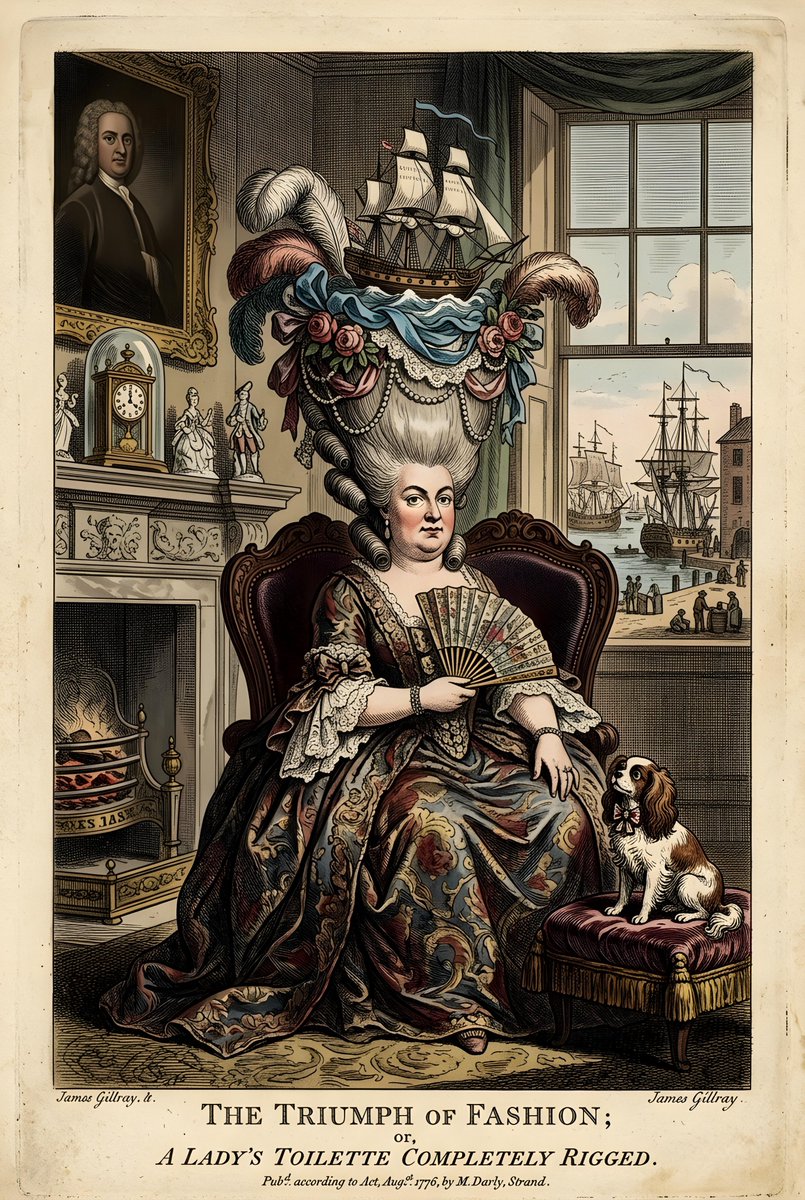
A vintage British caricature depicts a woman with an elaborate hairstyle adorned with a sailing ship, flowers, and feathers. She is seated in an ornate chair, wearing a richly decorated dress and holding a fan. The background shows a lavish interior with a fireplace, clock, and a window overlooking a harbor scene. A small dog sits on a cushion to her right. The overall style is that of a 18th-century satirical print.

@Heather Green
Infographic / Edu Visual - Vintage Travel Journal Editorial Collage
Nano Banana Pro

Infographic / Edu Visual - Vintage Travel Journal Editorial Collage

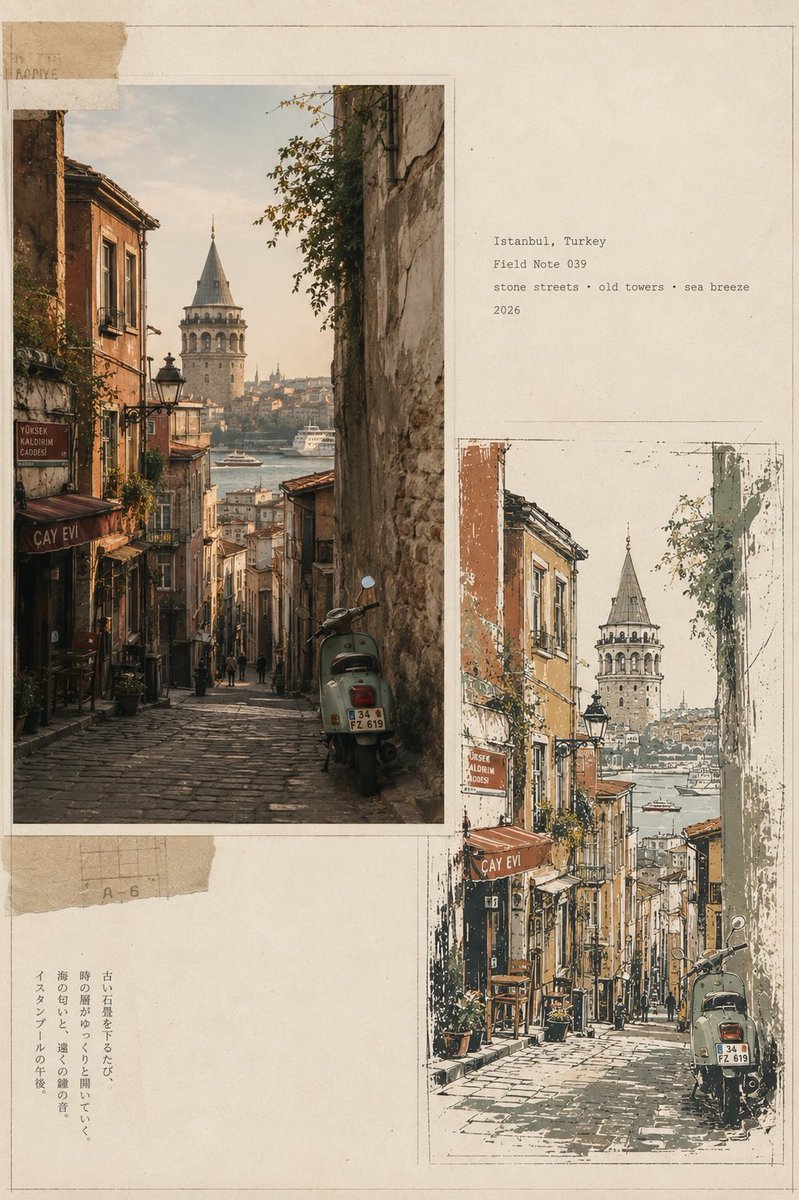
Create a premium vintage Japanese travel-journal editorial collage in vertical 4:5 format, featuring four distinct city sections—Bangkok, Thailand; Lisbon, Portugal; Marrakech, Morocco; Istanbul, Turkey. Each section combines a warm photorealistic documentary street photograph with a matching imperfect hand-drawn screen-print illustration, arranged asymmetrically on aged cream paper with torn-paper layers, archival borders, subtle pencil marks, typewriter captions, faded ink, paper fibers, and authentic 35mm analog grain. Bangkok: shrine, tangled wires, tropical greenery, teal motorbike; Lisbon: yellow tram, steep cobblestone street, balconies and river view; Marrakech: terracotta medina, palms, rugs and ornate minaret; Istanbul: steep stone street, Galata Tower, Bosphorus and vintage scooter. Use a restrained palette of sage, ochre, terracotta, mustard, charcoal and warm ivory, with sophisticated editorial art direction, muted contrast, natural light, handmade imperfections, and museum-quality travel-zine aesthetic.

@lovimg_com
Infographic / Edu Visual - Editorial Cooking Storyboard Layout
Nano Banana Pro

Infographic / Edu Visual - Editorial Cooking Storyboard Layout

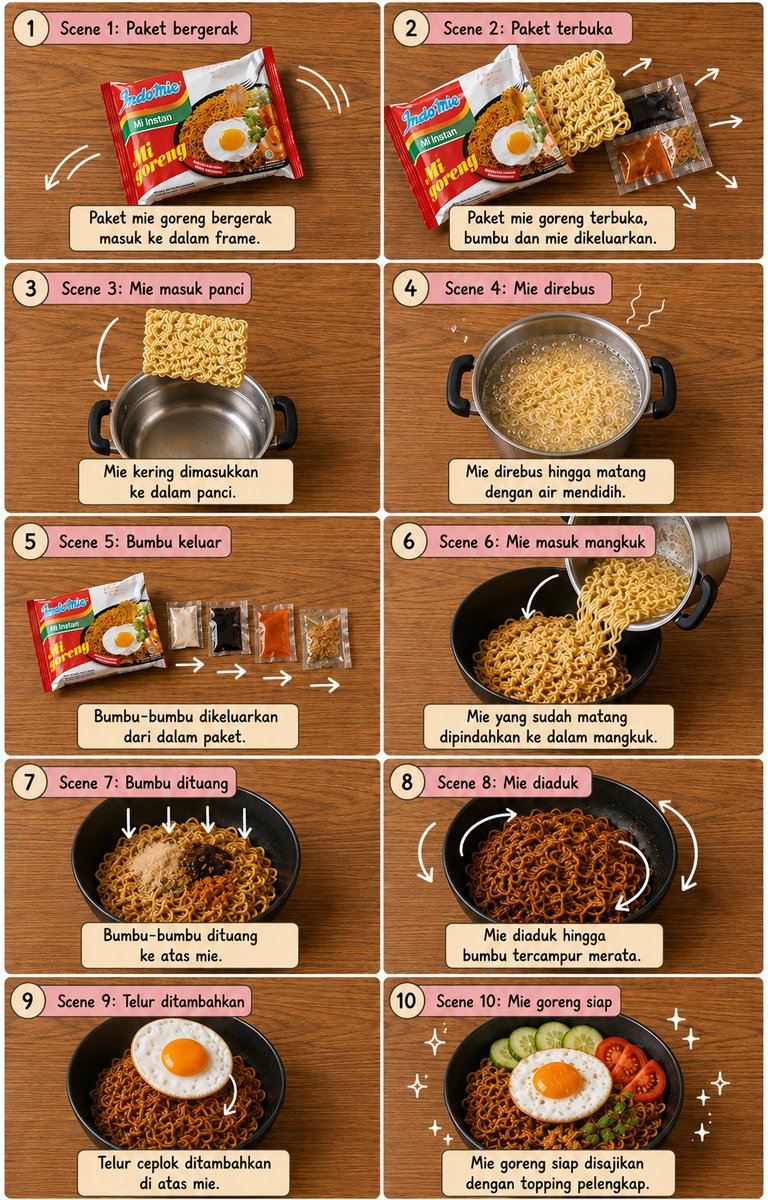
Create a vertical 4:5 cooking storyboard with exactly 10 panels in a {argument name="grid" default="2×5 grid"}. {argument name="surface" default="warm wooden tabletop"}, perfect top-down view, thin white borders, dusty-pink rounded headers, cream caption boxes, numbered circles and black handwritten typography.\n\nShow the exact sequence: {argument name="dish" default="dish"} packet → packet opens → noodles enter silver pot → noodles boil → seasoning sachets come out → cooked noodles enter black bowl → seasonings fall in → noodles mix → fried egg placed on top → finished mie goreng with egg and garnishes.\n\nUse clear white curved arrows, motion lines and sparkles to show every movement. Keep identical object continuity, realistic food, warm lighting, clean cute editorial storyboard style, sharp details and balanced spacing. No people, no hands, no extra panels.

@𝐌

Some prompts are collected from creators on X. Copyright belongs to the original authors.